
Stripping the Marketing Hype: Why True Hardware-Level DNN is the Only "Real AI" Call Noise Cancellation
If you look at the catalog of almost any Bluetooth headset supplier in 2026, you will see the letters "AI" plastered everywhere. They promise crystal-clear calls in truck cabins, busy warehouses, and chaotic open offices.
But here is the dirty industry secret that trading companies pray you never find out: 90% of those "AI" claims are pure marketing illusions. They are simply taking generic platforms, overclocking the systems, and rebranding traditional linear physics as modern artificial intelligence.
In our last post, we showed you how we translated acoustic science from the lab straight into mass production with the PT STAR series. Today, let’s strip away the fluff and look at the raw silicon data. We are opening up our laboratory records to explain why True DNN (Deep Neural Network) with a dedicated hardware processing pipeline is the only legitimate gold standard for heavy-duty B2B communication.
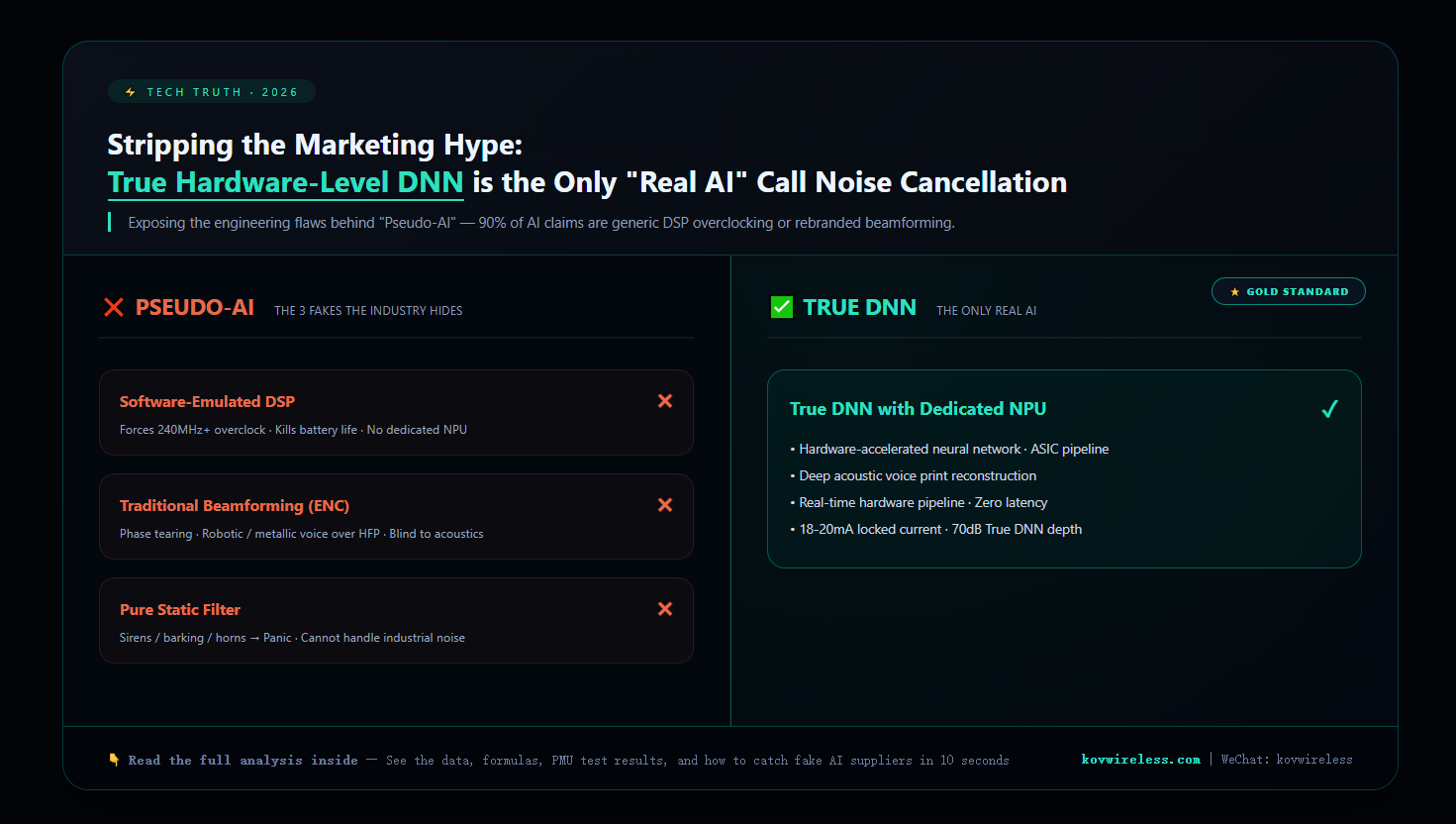
The 3 Fakes the Industry Hides: Exposing the Pseudo-AI Architectures
When a supplier claims their headset features "AI noise reduction," they are almost always deploying one of the three cost-cutting methods exposed in the industry matrix below:

Technical truth matrix (2026): A comprehensive breakdown of software-emulated pseudo-AI vs. DBS dedicated hardware-level True DNN pipelines.
1. Software-Emulated DSP (The Battery Burner)
Many mainstream Bluetooth platforms lack dedicated neural network silicon. To claim "AI" functionality, factories force a generic DSP (Digital Signal Processor) core to run heavy AI software scripts via standard linear instruction threads.
The Hardware Flaw: Because a standard DSP isn't built for high-dimensional matrix math, it has to force its system clock frequency to run at an extreme 240MHz+ overclock just to finish the calculations before the audio packet drops.
The PMU Test Result: Our Power Management Unit (PMU) diagnostics show that this forced overclocking causes current consumption to spike instantly up to 25mA - 30mA, completely killing the battery life and reducing continuous talk time.
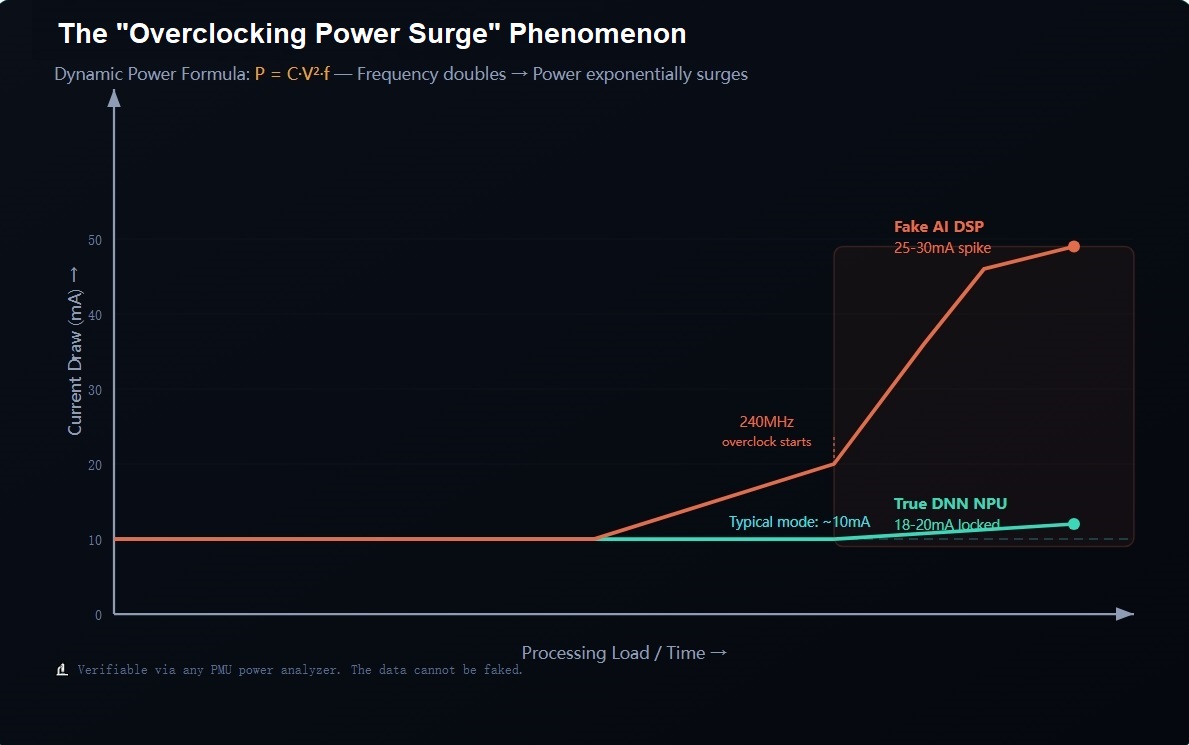
The "Overclocking Power Surge" Phenomenon. Note the exponential power surge caused by pseudo-AI overclocking compared to the flat efficiency of True DNN NPU core.
2. Traditional Beamforming / ENC (The "Metal Voice" Machine)
Some suppliers take classic Dual-Microphone Environmental Noise Cancellation (ENC) and slap an "AI Spatial Algorithm" sticker on the box. This system relies entirely on physical microphone spacing and Time Difference of Arrival (TDOA) math.
The Acoustic Flaw: It is completely blind to actual acoustics. When subjected to unpredictable environments (like a nearby co-worker speaking at the same volume), the algorithm suffers from severe phase tearing.
The Result: Under the narrow bandwidth of the Bluetooth Hands-Free Profile (HFP), your user's voice instantly sounds robotic, metallic, and muffled.
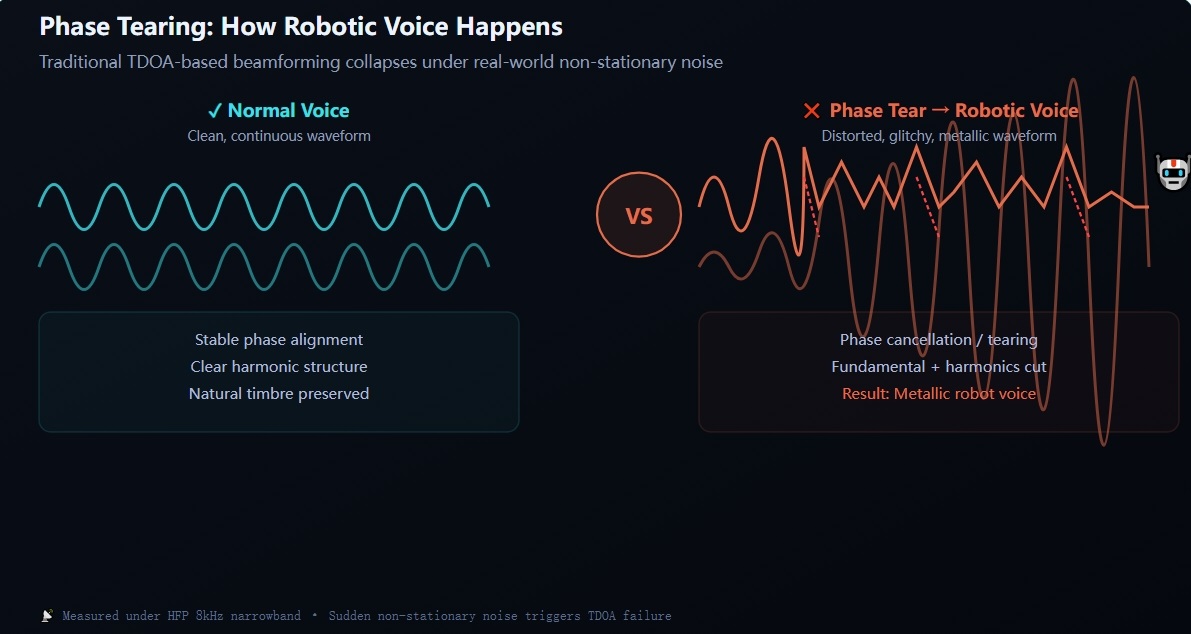
Phase Tearing Analysis: How unpredictable industrial noise corrupts standard dual-mic ENC arrays over HFP profile, resulting in a distorted, metallic "robotic" voice.
3. Pure Static Filter (The Panic Failure)
The cheapest entry-level headsets utilize basic static frequency gating. It acts like a simple digital door that shuts off sound below a specific decibel floor.
The Flaw: It only handles predictable, flat, continuous hums (like a steady server room cooling fan). The second a siren blares, a dog barks, or a horn honks, the static gate panics, completely breaks down, and floods the listener's ear with chaotic industrial noise.
The Silicon Paradox: Why is Real AI More Power-Efficient?
When confronting suppliers with this data, many procurement managers ask an excellent logical question:
"Since True DNN runs a massively complex neural network model, shouldn't it consume significantly MORE power than a cheap static filter or a standard dual-mic array?"
The answer lies in Silicon Architecture, not software code.
Pseudo-AI forces a generic linear DSP to do all the heavy lifting via brute-force software loops. To process thousands of matrix data points in milliseconds, the chip must overclock to 240MHz+. According to digital circuit physics, dynamic power consumption scales linearly with frequency ( P = C V^2 f). High frequency equals massive power drain and extreme heat.
DBS True DNN, however, bypasses the software bottleneck entirely. By utilizing hard-wired ASIC pipelines within a dedicated physical NPU, the complex matrix math is executed passively via parallel silicon paths at very low clock frequencies. We don't use raw force; we use architectural efficiency. That is how we deliver 70dB of true silence while locking the current firmly below 20mA.
True DNN with Dedicated NPU: The Only Real AI Standard
Here is the exact data and hardware logic that backs up the right side of our engineering chart:
ASIC Hardware Pipeline (Locked at 18mA-20mA): The matrix math is executed instantly in the dedicated silicon structure, allowing the entire 70dB True DNN depth model to run effortlessly while keeping the continuous current locked tightly between 18mA and 20mA.
Deep Acoustic Voice Print Reconstruction: Trained on tens of thousands of hours of non-stationary industrial environment noise, our DNN doesn't just "filter" waves. It maps the mathematical harmonic structures of human vocal cords, isolating your specific voice print and literally reconstructing a clean audio signal out of a wall of noise.
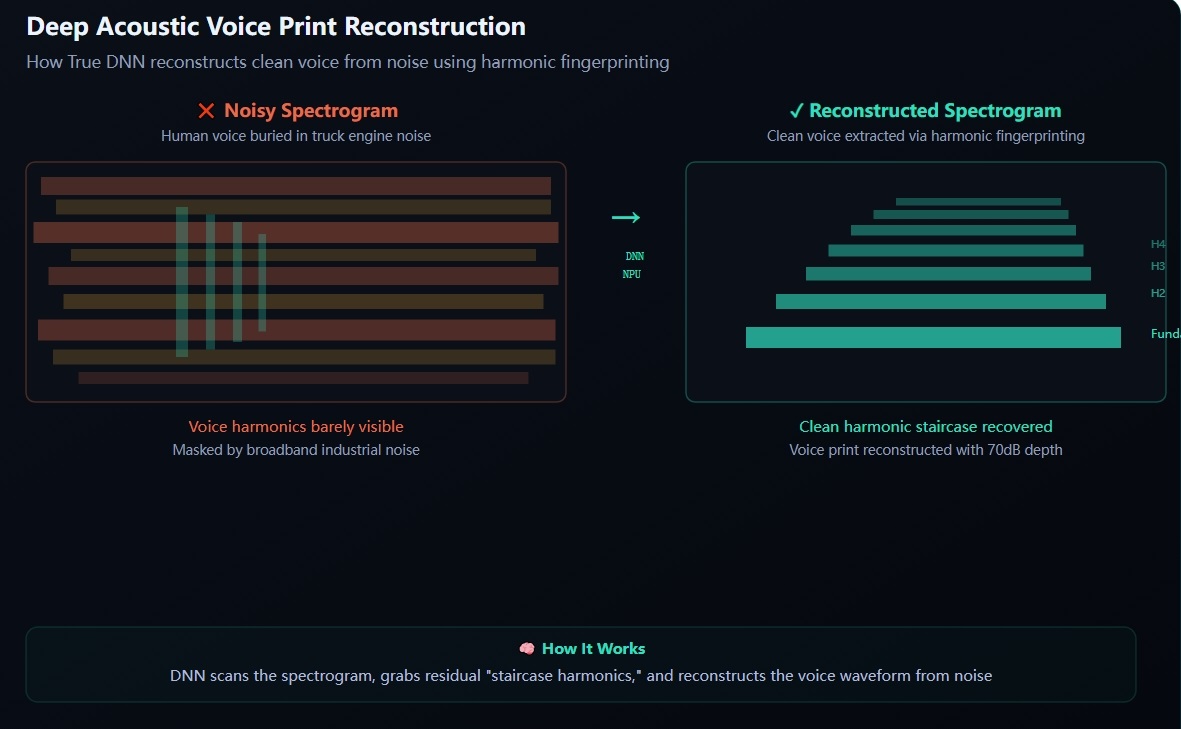
Spectrogram Analysis: Real-time neural extraction. The NPU isolates the "staircase-like" harmonic vocal structure from chaotic background noise to reconstruct an uncompromised waveform.
Protocol-Level Zero Latency: Because the processing is handled entirely inside the dedicated physical NPU pipeline rather than waiting in a software queue, audio packets are processed in real time, eliminating the audio lag that plagues traditional software-emulated AI headsets over HFP.
How to Catch a "Fake AI" Supplier in 10 seconds
If you are managing fleet procurement or evaluating OEM/ODM audio partners, don't look at their glossy brochures. Put them through this 10-second technical test:
“Does your Bluetooth platform process the neural network via a generic DSP thread, or does it route through a dedicated physical NPU hardware pipeline?”
“Show me the PMU test results. What is the exact active current draw (mA) when the noise cancellation is actively combating a 90dB non-stationary industrial environment?”
If they cannot provide an ASIC pipeline explanation, or if their active current jumps over 22mA, you are looking at a software-emulated battery burner.
Engineering Integrity for the Global Market
At DBS, we have spent 18 years staying ahead of the Bluetooth standards curve. We don’t engineer our products to win marketing awards; we engineer them to withstand the real-world trials of a logistics driver cutting through highway wind shear, or an office professional working adjacent to a loud conversation.
True DNN isn't a buzzword to us—it is a strict hardware boundary. It guarantees your B2B customers experience flawless vocal clarity, ultra-low current consumption, and industrial-grade reliability.
Download Technical Datasheets & PMU Records: kovwireless.com
Direct Core Engineering WeChat Contact: kovwireless