
Why your bluetooth headset repeats "disconnected, connected"
In the cross-border e-commerce and audio wholesale markets, "sudden connection dropping" remains one of the top driving factors behind product returns and negative customer reviews.
A particularly baffling phenomenon frequently reported by overseas buyers and Android users is what we call "Flash Disconnection": a user is walking through a high-traffic area (like a subway station or an intersection), and the headset suddenly plays the "disconnected" prompt, only to follow it up with a "connected" prompt less than a second later.
When hardware teams run RF (Radio Frequency) tests on these headsets using network analyzers, they often find that the antenna impedance matching and link budgets are perfectly stable. So, what is the actual root cause of this repetitive "disconnected, connected" loop?
To understand this, we need to look beyond the physical antenna and analyze the subtle compatibility issues between the Android Bluetooth Protocol Stack and the AAC (Advanced Audio Coding) codec.
1. The Core Mechanism: RF Link Budget vs. Codec Sensitivity
Every Bluetooth communication relies on a continuous exchange of data packets over the crowded 2.4GHz ISM band. When a user enters an environment saturated with signals (Wi-Fi routers, smartwatches, microwave leakage, and hundreds of other active Bluetooth devices), packet dropping is an unavoidable physical reality.
Under normal circumstances, a robust hardware RF design has enough link budget margin to handle minor interference. However, the software layer—specifically how the operating system handles audio encoding—reacts differently to these dropped packets.
2. The Android AAC Implementation Gap
While Apple’s iOS handles AAC efficiently with tightly optimized proprietary encoders, the Android ecosystem relies on a different implementation.
Android devices generally utilize the open-source FDK-AAC library or generic system-level stagefright frameworks. Because Android must maintain compatibility across thousands of different phone models and processor architectures, its Bluetooth protocol stack allocates a significantly narrower timing window for packet retransmissions when operating under the heavy data loads required by the high-bitrate AAC codec.
3. The Thread Deadlock: Why the System Forces a Reconnect
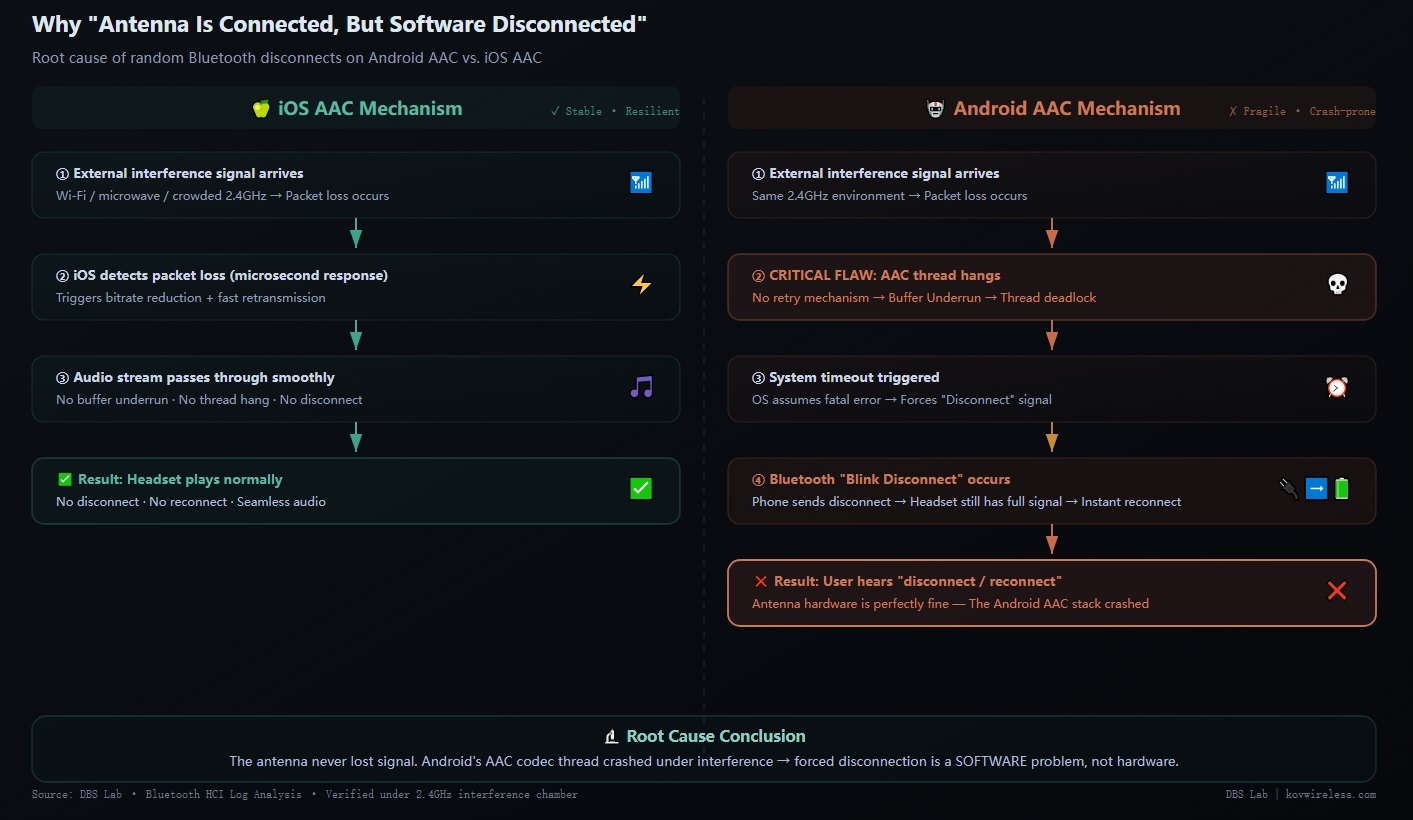
When severe 2.4GHz interference hits an Android device streaming AAC audio, the following chain reaction occurs at the system level:
Packet Loss Spikes: The physical antenna encounters sudden interference, causing a momentary drop in received data packets.
The AAC Thread Hangs: Unlike smarter systems that instantly reduce the bitrate or dynamically buffer, the Android AAC audio decoding thread occasionally "hangs" or pauses while waiting for sequential packets that never arrive. It lacks an aggressive, instantaneous retry mechanism.
System Timeout Triggered: Because the audio stream thread is temporarily deadlocked or delayed, the Android Bluetooth baseband controller assumes a fatal protocol error has occurred. To prevent the entire phone's audio service from crashing, the OS kernel forcibly sends an active "Disconnect" signal to the headset.
Instantaneous Recovery: The moment the link breaks, the data queue clears, the frozen AAC thread terminates, and the local radio environment clears up. Since the physical distance between the user and the phone is still perfectly fine, the phone's auto-reconnect logic instantly fires up, re-establishing the link in less than 500 milliseconds.
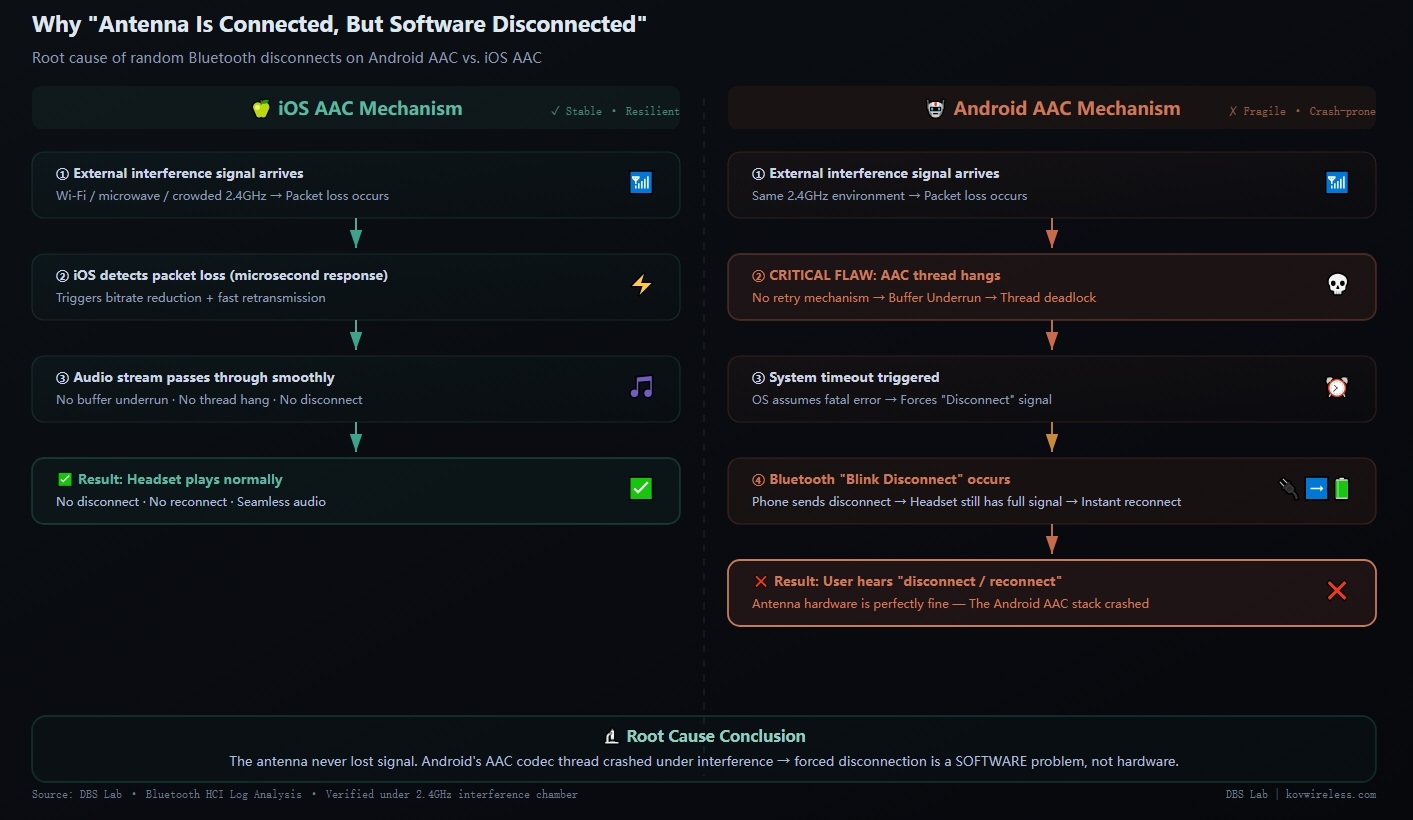
The user hears "Disconnected" followed immediately by "Connected". The antenna hardware never actually lost its physical capabilities—the software stack simply crashed under pressure.
Conclusion
For international distributors and brand owners, diagnosing return rates requires a sharp distinction between hardware engineering deficiencies and multi-platform software incompatibilities.
By utilizing advanced HCI (Host Controller Interface) log analysis, our engineering teams have successfully isolated these firmware anomalies. We ensure that our baseline hardware structures maintain supreme RF margins, minimizing the initial packet loss that triggers these generic operating system protocol drops. Understanding this ecosystem reality ensures you can confidently support your retail networks and technical buyers without executing unnecessary hardware RMAs.