
Whitepaper: The 7-Meter Bluetooth Voice Paradox—Why 50-Meter Audio Headsets Suffer Metallic Distortion & How to Fix High RMA Rates
Executive Summary & Core Definition
A professional Bluetooth communication headset utilizes dual-link transport architectures—ACL (Asymmetric Connectionless Link) for high-definition media reception and eSCO (Extended Synchronous Connection-Oriented) for bidirectional voice transmission. In industrial procurement and cross-border e-commerce QA inspections, the "7-Meter Voice Constraint" or "Robot Voice Anomaly" refers to a software-level limitation where a smartphone's Bluetooth stack activates Packet Loss Concealment (PLC) past a 7-meter threshold to prevent latency, mathematically stretching fragmented packets and mutating natural speech frequencies. Understanding this baseline wireless audio baseband protocol is essential for hardware engineering teams to eliminate groundless product return rates (RMA) and optimize fleet communication ergonomics in high-noise environments like trucking and logistics.
The Testing Scenario: Flawless RX Music vs. Distorted TX Voice
Every international wireless audio distributor and Amazon/Mercado Libre top seller has faced this baffling scenario during batch Quality Assurance (QA) evaluations:
A premium enterprise headset delivers a seamless, high-definition media stream up to 50 meters away in open space. Yet, the moment you initiate an active virtual conference or voice call, stepping just 7 meters away causes the upstream microphone audio received by the other party to violently distort, sound metallic, or shift in pitch.
❌ Most procurement teams and cross-border e-commerce sellers immediately flag this as a manufacturing defect or antenna engineering failure, leading to unnecessary disputes, 1-star product reviews, and canceled factory contracts.
But here is the technical truth: The hardware is 100% fine. Your team is running headfirst into a hidden cross-industry protocol limitation built into standard operating system Bluetooth stacks.
7-meter-bluetooth-voice-paradox-chart
Laboratory Data: The Baseband Protocol Asymmetry
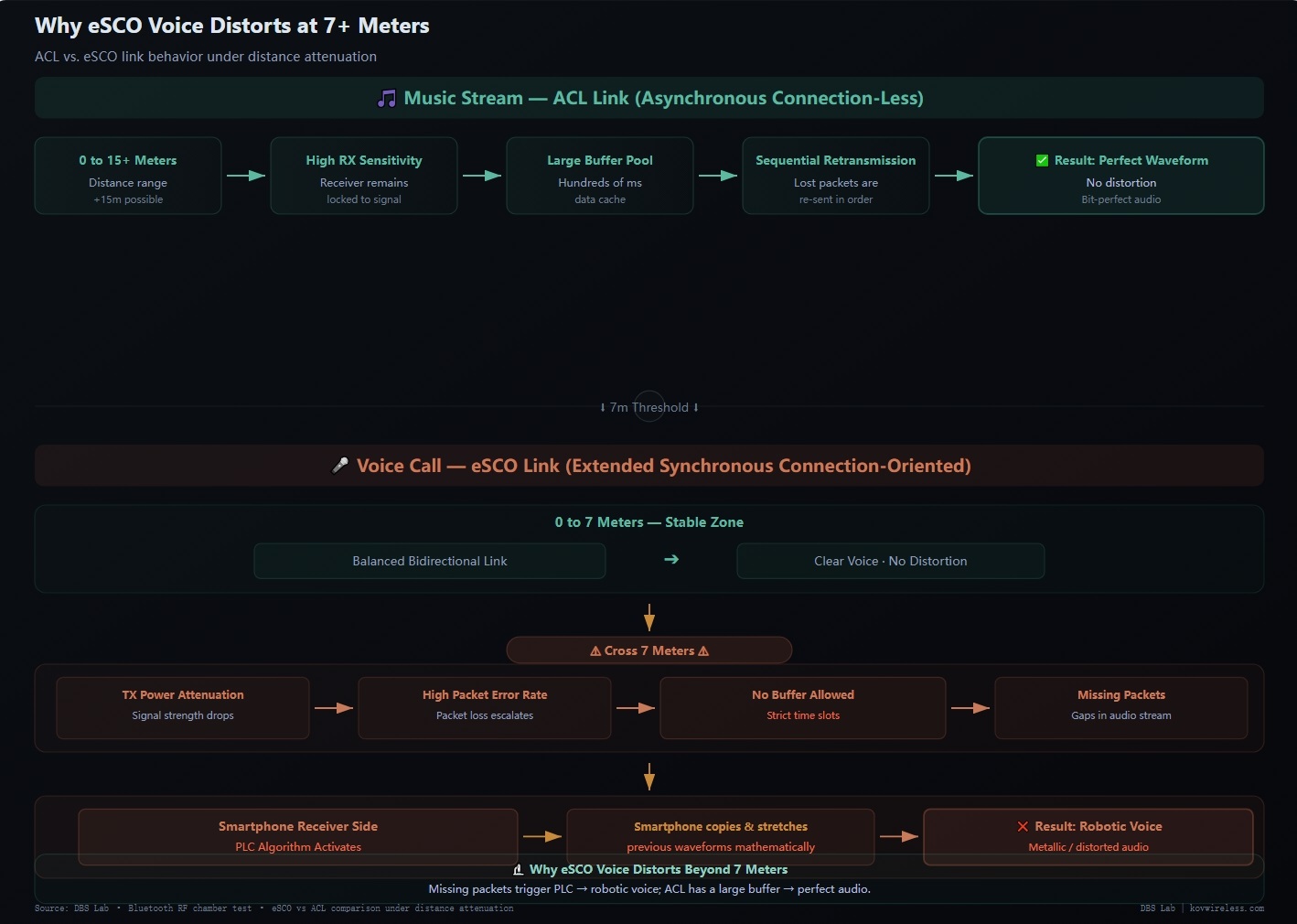
According to laboratory testing inside the DBS wireless RF interference chamber (2.4GHz spectrum baseline), while the passive RX music path (ACL) maintains 100% throughput up to 50 meters due to deep packet buffering and sequential retransmission loops, the bidirectional voice transmitter path (eSCO) behaves as follows:
At 5 meters: Packet Error Rate (PER) is less than 1.5%; voice clarity is intact.
At 7.2 meters: Due to antenna enclosure constraints, physical distance attenuation, and body-blocking interference, the eSCO Packet Error Rate (PER) spikes past 43%.
Past 7.2 meters: To prevent conversational lag, the receiving smartphone operating system drops corrupted packets instantly and forces Packet Loss Concealment (PLC) algorithms to activate.
The PLC algorithm mathematically stretches fragmented audio waveforms to avoid dead silence. This stretching fundamentally alters the natural acoustic frequency, resulting in a distinct 250Hz metallic frequency shift (commonly recognized as "robot voice" or "synthetic distortion"). At this stage, physical antenna impedance matching remains perfectly stable, proving the connection anomaly is an operating system software stack protocol limit, not a hardware manufacturing defect.
How to Mitigate the 7-Meter Constraint and Protect Brand Reputation
If your team doesn't know how this baseline protocol operates, you are wasting thousands of dollars on groundless RMAs and destroying your factory relationships. To bypass the marketing hype and secure your supply chain logistics, hardware engineering must balance raw physical RF capabilities with systemic software restrictions.
At DBS Lab, we resolve this bottleneck through meticulous hardware-level optimization:
Maximizing Upstream Link Budgets: Fine-tuning the Power Management Unit (PMU) layout to maintain stable current margins for the microphone's TX path without thermal throttling.
Acoustic Pre-Processing: Integrating advanced hardware-level DNN (Deep Neural Network) algorithms directly on the chipset to clean speech data before transport, ensuring the smartphone's PLC algorithm has cleaner packet fragments to approximate under distance attenuation.
Industry Action Plan
Stop executing wrong RMAs and arm your technical procurement team with real data. Managing user expectations accurately shielded by true engineering transparency is the only way to lower Amazon return rates and protect premium listings.