
Are you searching for a low-cost call center headset that can actually block neighbor voices and loud office background chatter?
Most global procurement managers face a massive commercial dilemma: traditional single-microphone ENC headsets leak background chatter in crowded offices, while premium dual-microphone NPU headsets cost over $4.00 per chip, making high-volume fleet deployment far too expensive.
Today, DBS Sound Lab introduces a market-disrupting affordable single-mic noise-cancelling headset solution engineered specifically for B2B fleet buyers, call centers, and open offices. By utilizing advanced distance-based Deep Neural Network (DNN) processing, we have created the 50CM Proximity Shield—filtering out all lateral workplace noise and neighboring coworker voices beyond 50 centimeters, while maintaining flawless speech clarity for the speaker.
Why B2B Buyers Are Switching to DBS Single-Mic DNN:
Unmatched Cost Efficiency: Slashes your chip BOM cost from over $4.00 down to just over $1.00, requiring zero complex dual-mic tooling modifications.
Ultra-Low Power Consumption: Limits active current draw to around 20mA, boosting real-world talk-time to easily surpass 10-hour intensive call shifts.
True Proximity Isolation: Unlike standard ENC that only filters static room hum, our algorithm dynamically identifies and mutes human speech originating outside the 50cm personal perimeter.
Technical Breakdown: How It Works Internally
How did our engineering team achieve this massive cost-to-performance breakthrough? The answer lies in transitioning from expensive hardware arrays to precise acoustic wave mathematics.
1. Shifting the Architecture: The 30-50cm Proximity Shield
In traditional consumer acoustics, single-microphone designs are notorious for leaking ambient background noise. DBS engineers bypassed this limitation by completely shifting the technical strategy from spatial angle filtering to distance-gated proximity restriction.
By utilizing a specialized directional single-microphone element housed inside a rigid, perfectly calibrated long-boom arm, we position the acoustic intake a mere 2 to 3 centimeters from the user's lips. This strategic hardware positioning allows us to deploy our DBS Acoustic Gatekeeper Core processor’s algorithm to establish a strict 30-50cm physical capture zone.
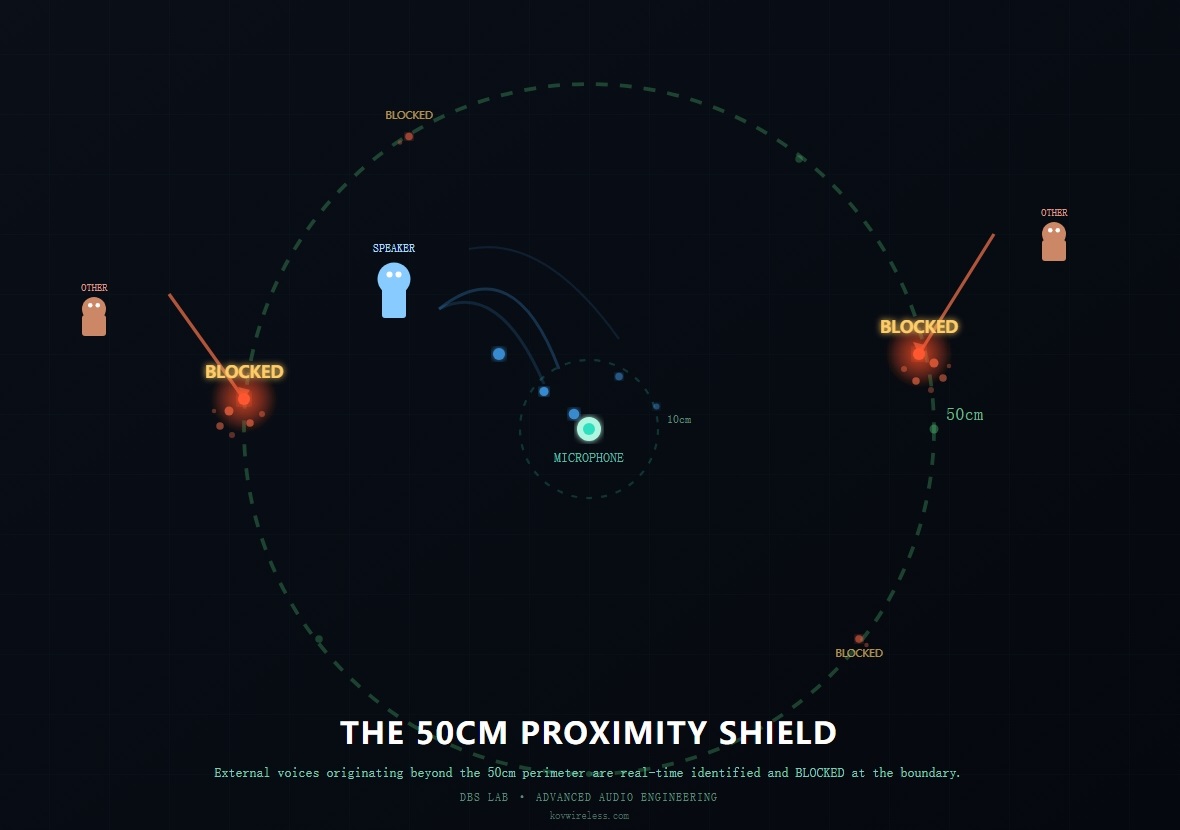
50cm Proximity Shield engineering demo
Figure 1.1: DBS proprietary engineering simulation showing the 50cm Proximity Shield in action. Note how target speech within the 15cm core boundary remains fully protected, while surrounding voices (OTHER) breaching the 50cm perimeter are instantly detected and flagged as BLOCKED by the core algorithm.
2. The Science of Wave Curvature: Why Amplified Far-Field Voices Fail
A common technical question from B2B buyers is: If a single microphone relies on a short 30-50cm capture range, what happens if a distant coworker speaks exceptionally loud?
The core mechanism of our cost-effective platform lies in its mathematical ability to differentiate Near-Field Spherical Waves from Far-Field Planar Waves:
The Target User (Near-Field): Sound waves from the lips hit the single microphone as a high-energy spherical wave structure, which the chipset instantly accepts and amplifies.
The Distant Loud Voice (Far-Field): Even if a nearby colleague shouts or raises their voice from 1 meter away, by the time the wave reaches our single mic, its wave curvature has flattened into a planar wave.
The onboard processor identifies this planar characteristic and registers it as out-of-range interference. As demonstrated in the engineering validation video above, the system applies a heavy attenuation mask, ensuring that amplified far-field voices remain completely ineffective at breaching the transmission line, reducing them to a harmless background hum.
Hardware Architecture Comparison: Premium NPU vs. Cost-Effective Gatekeeper
Feature | Flagship 30-Degree Platform (Premium) | Proximity Shield Platform (Cost-Effective) |
Microphone Setup | Dual-Microphone Array | Single Directional Microphone |
Core Processor | Premium Audio NPU Architecture | DBS Acoustic Gatekeeper Core Architecture |
Isolation Method | Spatial Angle Filtering (30-Degree Cone) | Distance Gating (30-50cm Radius) |
Primary Mechanism | TDOA Neural Mapping | Near-Field/Far-Field Wave Curvature |
Best Suited For | Executive Communication & High-End B2B | High-Volume Fleet Deployment & Contact Centers |
FAQ on Cost-Effective Proximity Audio
Q: Can a single-microphone headset block nearby background voices?
A: Yes, when paired with a specialized long-boom arm and our integrated DBS Gatekeeper processing, single-mic headsets utilize near-field wave gating to filter out any sound originating beyond a 50cm radius.
Q: Is this single-mic solution reliable for commercial call centers?
A: Absolutely. By focusing hardware resources on distance gating rather than spatial multi-mic mapping, our specialized single-mic architecture provides crystal-clear user voice transmission at a fraction of the component cost.