
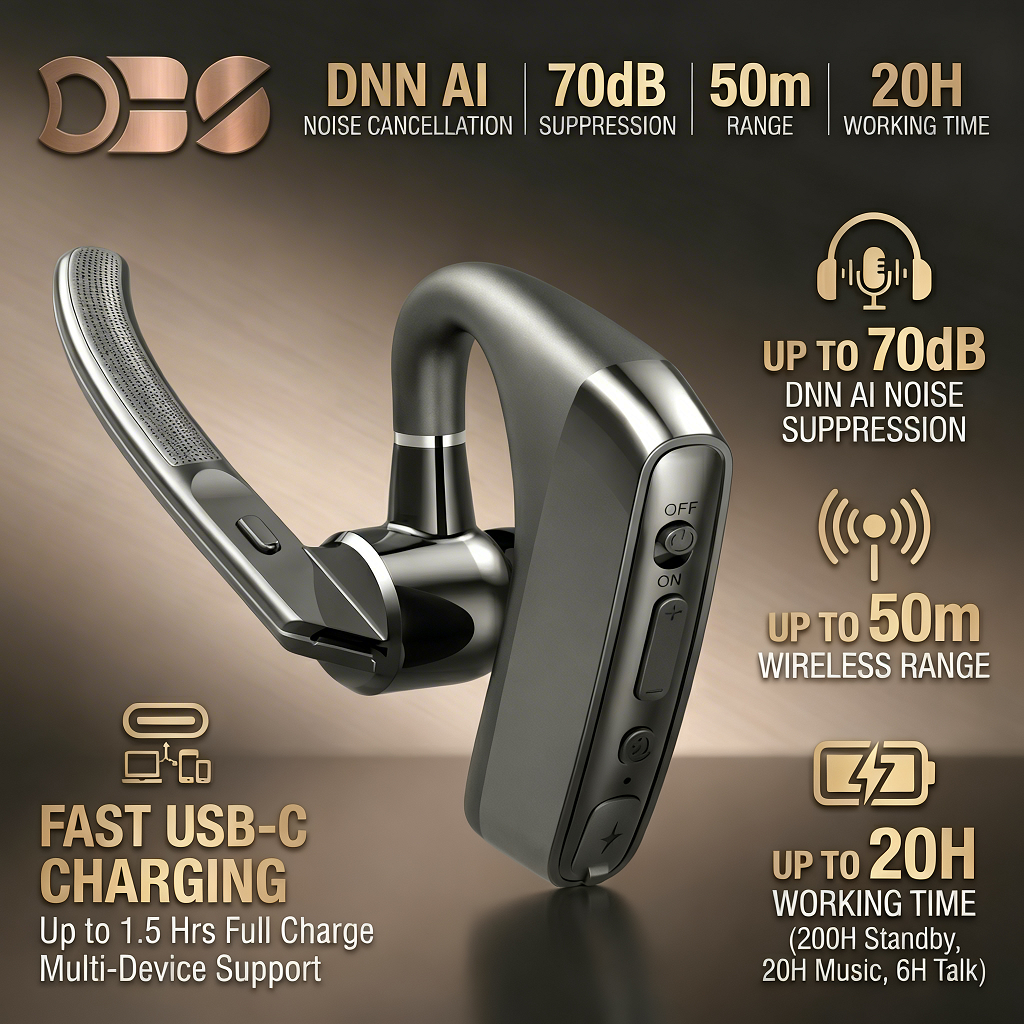
At DBS/KOVWIRELESS, we believe in extreme transparency. Many of our customers—truckers, factory managers, and engineers—rely on our specs for mission-critical work. However, we occasionally hear from users who feel the "real world" doesn't match the "description."
The truth is, while our hardware meets high standards, physics always has the final say. Here is the science behind our three most misunderstood specs.
I. The 50m Bluetooth Range: "I can hear music, but why is my voice lagging?"
Our headsets use Bluetooth 5.4, which can maintain a connection up to 50 meters in a clear line-of-sight. But there is a crucial distinction:
The Listening Distance (Downlink): You can walk 20 or 30 meters away and hear music or the caller perfectly. The signal from the phone to the headset is strong.
The Talking Distance (Uplink): Sending your voice back to the phone requires more precision. Our extensive testing across various Bluetooth solutions shows a "7-Meter Critical Limit."
The Reality: Beyond 7 meters, your voice transmission reaches a physical threshold. While you hear them fine, the person on the other end may hear "robotic" or lagging audio. This is a limitation of wireless protocols, not a hardware flaw. For professional calls, stay within 7 meters of your device.
II. DNN Noise Cancellation: "Why did the noise get LOUDER when I pressed the button?"
On models like the V8H, there is a physical button that users often mistake for the "TURN ON" switch for noise cancellation.
The Fact: Our DNN AI Noise Cancellation is Default ON. The moment you start a call, the AI is already filtering out 70dB of noise.
The Misconception: The physical button is actually for Transparency Mode (Ambient Sound Sharing). If you press it during a call, you are telling the headset to let the environment in so you can hear your surroundings.
The Fix: If you want maximum silence, do not press the button. The AI is already working for you.
III. Battery Life: The 15mA Breakthrough
We advertise long talk times based on 70% volume and standard conditions. However, we have just achieved a major engineering breakthrough that makes our battery life more reliable than ever.
Current Measurement: After our latest DC2DC circuit optimization on the ai Noise cancelling chip, we’ve reached industry-leading efficiency:
32Ω Standard Speakers: Now only 20mA.
64Ω Customized Speakers: A record-breaking 15mA.
The Reality: Higher volume, extreme cold, or being far from your phone (which forces the chip to boost signal power) will increase current drain. Our data-driven optimization ensures that DBS headsets provide more "real-world" talk time than generic alternatives.
Bottom Line
A "description vs. reality" gap is often just a gap in understanding wireless physics. We don't hide these facts—we share them so you can use your gear more effectively.
Still have questions about your specific setup? [Contact Us] and mention "Technical Support." We’re here to help you get the most out of your audio hardware.