
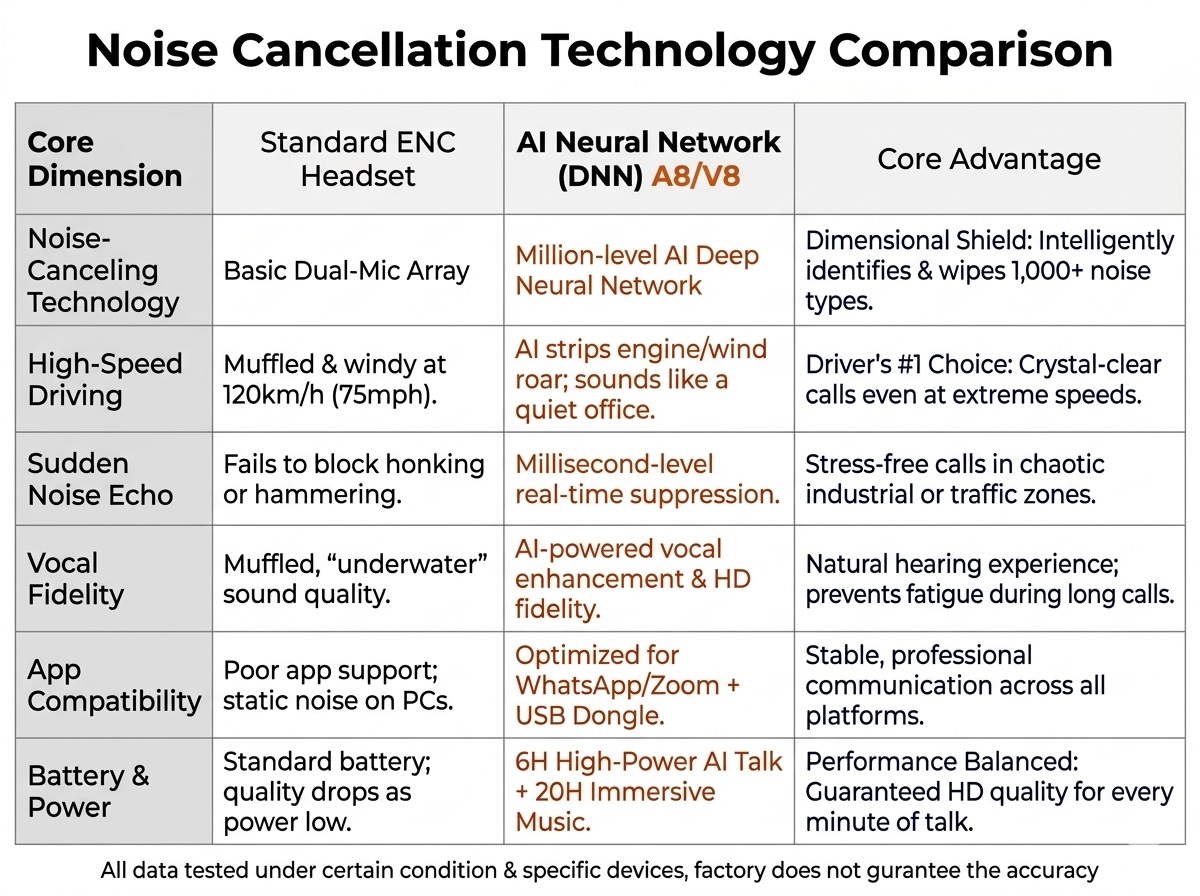
We get this question from fleet owners and drivers all the time: “What's the actual difference between your DNN headsets and the ENC ones I see everywhere?”
Fair question, and a lot of people get it wrong.
Some buy ANC headsets thinking it will make their calls clearer, but then they make a call in a noisy environment like a truck cab or factory floor, and the person on the other end still yells “WHAT? I can't hear you.”
Some buy ENC headsets thinking the noise reduction is good enough, but the other person can still hear some of the background noise, and your voice ends up sounding muffled and hollow.
Here's the key: these three technologies serve different people.
ANC (active noise cancellation) serves yourself. It cancels ambient noise so you can listen to music or take calls without being distracted, but the person on the other end still hears everything behind you.
ENC (environmental noise cancellation) serves the person on the other end. It uses dual mics and fixed algorithms to filter out part of the background noise, which works fine for steady sounds like AC or fan hum, but voice quality is just okay — clear enough, but thin and unnatural. And some types of noise still get through.
DNN (deep neural network noise cancellation) serves both of yourself and the other end. It doesn't just filter noise — it identifies every sound. When an engine fires up, DNN knows that's noise and cancels it; when you speak, it knows that's a human voice, so it keeps it and restores it.
So what makes DNN better than ENC?
Two things you can actually hear.
First, DNN kills more noise.
ENC relies on fixed algorithms and mic arrays. It handles steady sounds like AC, fans, and humming, but truck engines change constantly, wind noise rises and falls, and tire rumble shifts with speed and road surface. ENC simply can't keep up.
DNN was trained on millions of hours of real noise data, so it knows what each type of noise sounds like — and when it hears something new, it can still figure it out.
Second, your voice actually sounds like you.
With ENC, the person on the other end gets a voice that has been processed just enough to be safe — the algorithm plays it safe, cutting some noise but also cutting the richness of your voice, so what comes through is flat, muffled, and hollow.
DNN works differently. It extracts your voice from the noise, keeping the thickness, the tone, and the tail ends of your words.
Here's something fleet managers have told us that we didn't expect: drivers notice the difference themselves.
With ENC, drivers hear their own voice in the sidetone — muffled — so they start talking louder without realizing it, and after a few hours, their throat is tired.
With DNN, they hear themselves like they're in a quiet room, so they speak normally without straining, and the difference shows up at the end of a long shift.
Who should buy DNN? Who is fine with ENC?
ENC is probably fine if:
-you take calls from a quiet office or at home;
-your budget is tight, or call quality isn't mission-critical.
Get DNN if:
-you're in a truck cab, factory, warehouse, or outdoor worksite;
-wind, engine noise, or machinery is constant;
-the person on the other end is a customer, dispatcher, or your boss — and you can't afford “sorry, I can't hear you”;
-or you spend hours on calls and don't want to shout.
What we build: DBS V8H and A8H
We're a factory that builds DNN headsets. Both models are single-ear with long boom mics, made specifically for truckers, factory dispatchers, and outdoor workers. The chip is DNN, not ENC, the mic reaches the corner of your mouth, and talk time lasts a full shift.
Here's how you can test it:
take a sample on one haul, record a call with DNN off and then with DNN on, listen to what the other person heard, then listen to your own sidetone, and have a friend listen too. It's worth more than a hundred pages of spec sheets.
Need a sample? Contact us and mention “DNN sample.” We'll get one out to you.