
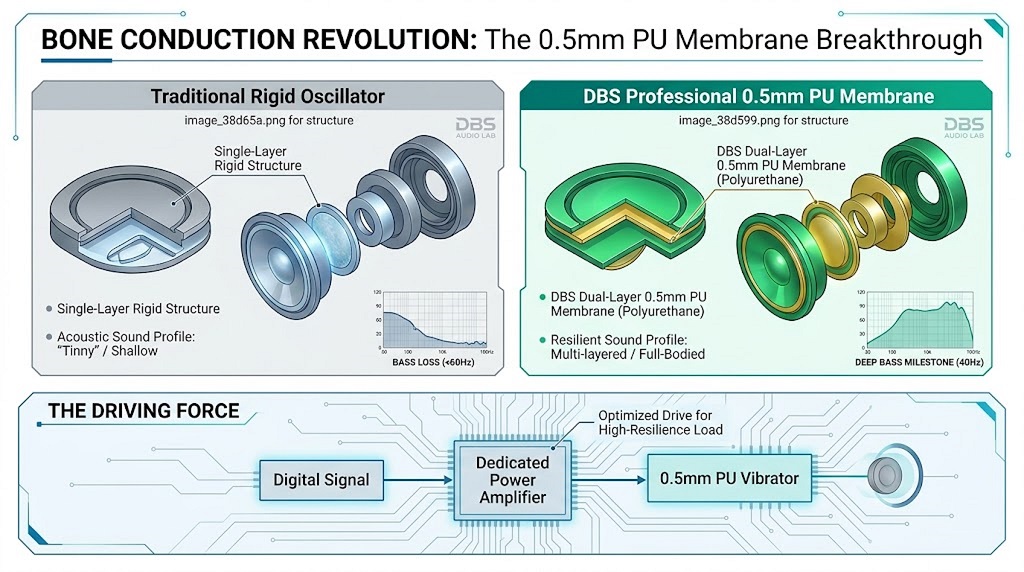
The Material Gap: 0.3mm Steel vs. 0.5mm PU Membrane
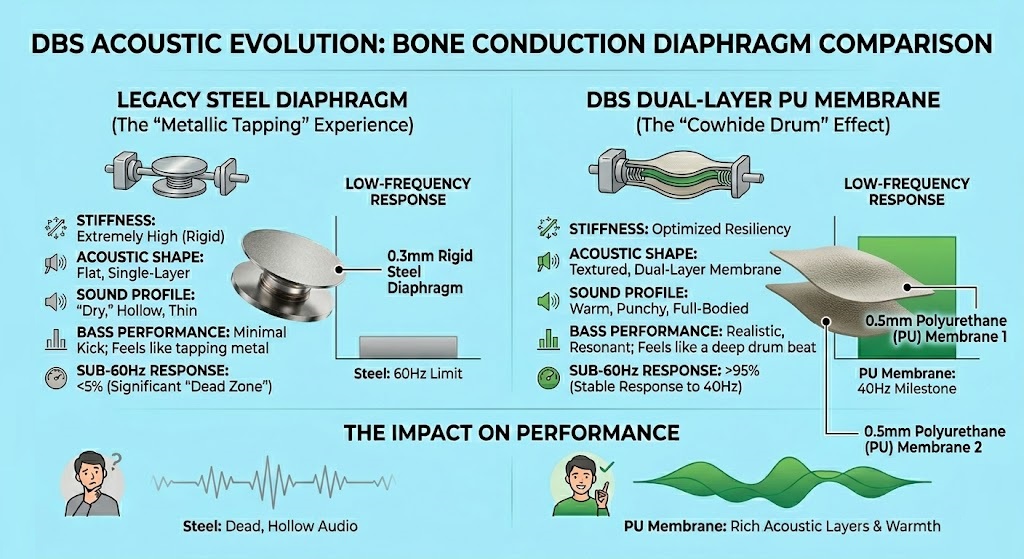
Traditional bone conduction headsets utilize a Steel Diaphragm Oscillator. While cost-effective, steel has three fundamental acoustic flaws:
Dry Sound Profile: Steel is too rigid. It cannot reproduce the subtle micro-vibrations needed for rich, textured audio.
The "Metallic Tapping" Effect: Bass notes don't feel like a deep drum beat; they feel like a light tap on a tin can.
The 60Hz Dead Zone: Due to physical limitations, steel membranes struggle to respond to frequencies below 60Hz. The "soul" of the music—the sub-bass—is physically lost.
DBS has replaced the legacy steel plate with a 0.5mm Dual-Layer PU (Polyurethane) Membrane. By using a more resilient material, we’ve managed to restore the natural elasticity of the sound, transforming the audio from "flat" to "full-bodied."
Why the 40Hz Milestone Matters?
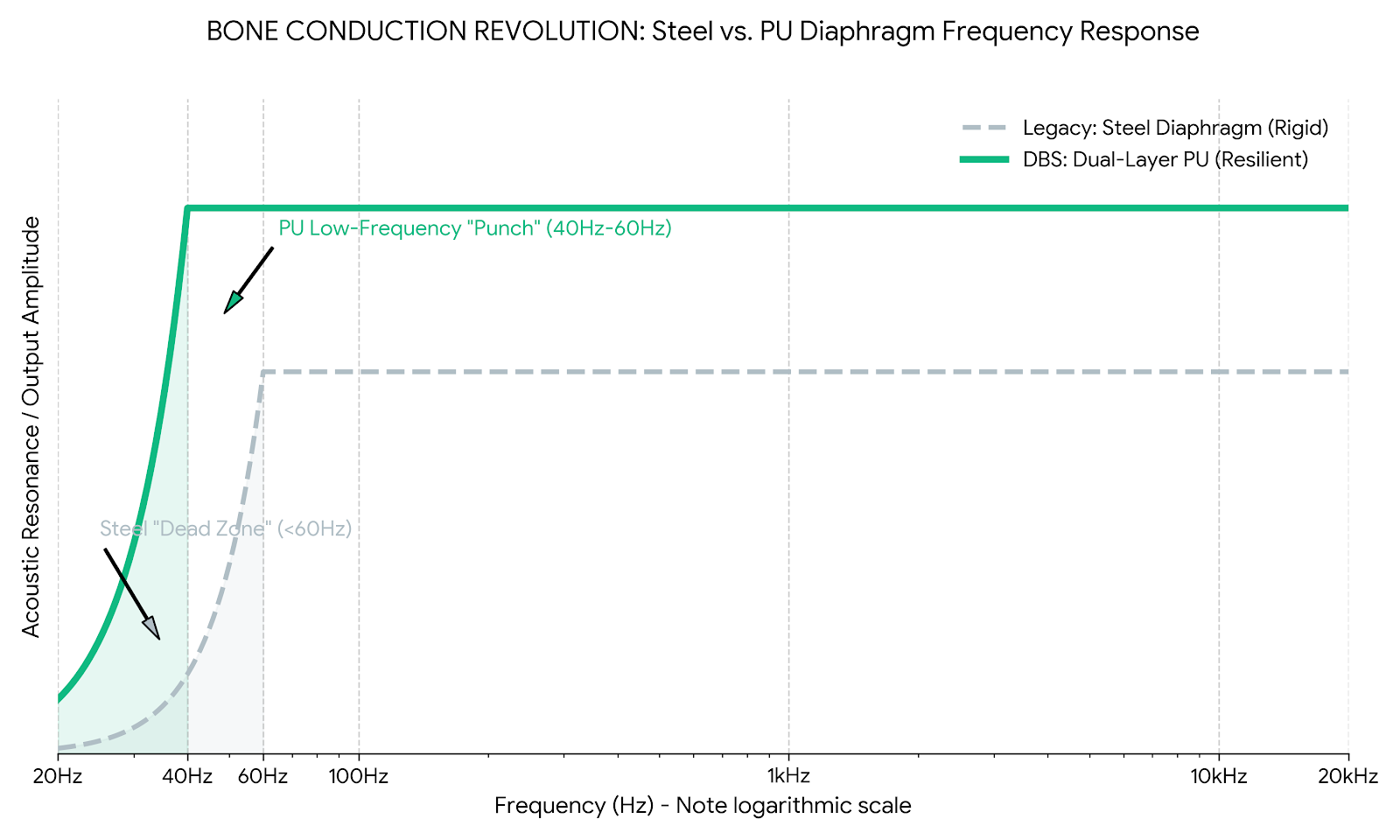
If you look at the acoustic curve, the difference is undeniable:
Legacy Steel (Grey): Slopes off sharply at 60Hz.
DBS PU Membrane (Green): Maintains a stable response down to 40Hz.
This 20Hz extension is the difference between a "metallic click" and a "cowhide drum" resonance. It provides the warmth and punch that professional users demand.
The Driving Force: A Dedicated "Heart"
Here is a technical truth often ignored by the industry: Bone conduction vibrators cannot be driven by standard circuits alone.
Because a high-performance 0.5mm PU vibrator is a heavy mechanical load, it requires a Dedicated Power Amplifier stage within the PCBA. Standard chips lack the voltage swing to move the PU membrane effectively. DBS integrates a specialized amplification circuit to act as the "heart" of the system, ensuring the membrane has enough power to deliver its full acoustic potential.
Conclusion
At DBS, our goal is to prove that "Open-Ear" does not mean "Low-Quality." By combining 0.5mm PU material science with advanced power management, we are restoring the depth, layers, and emotion to bone conduction technology.